7 Buffet Food Pan Buying Tips for Global Buyers
Buying a buffet food pan for international service is not as simple as choosing a shiny container. The right pan must fit the menu, equipment, serving volume, and daily cleaning routine. A small mismatch can create wasted food, uneven heating, or difficult storage. These seven buying tips examine the details global buyers often overlook.
Material matters. Food-grade stainless steel, especially durable 304 stainless steel, can handle frequent service and repeated washing. However, quality varies between suppliers. Ask for material specifications, thickness information, and product samples before placing a large order. Check the corners, welds, handles, and lid fit. Small defects become obvious during a busy breakfast service.
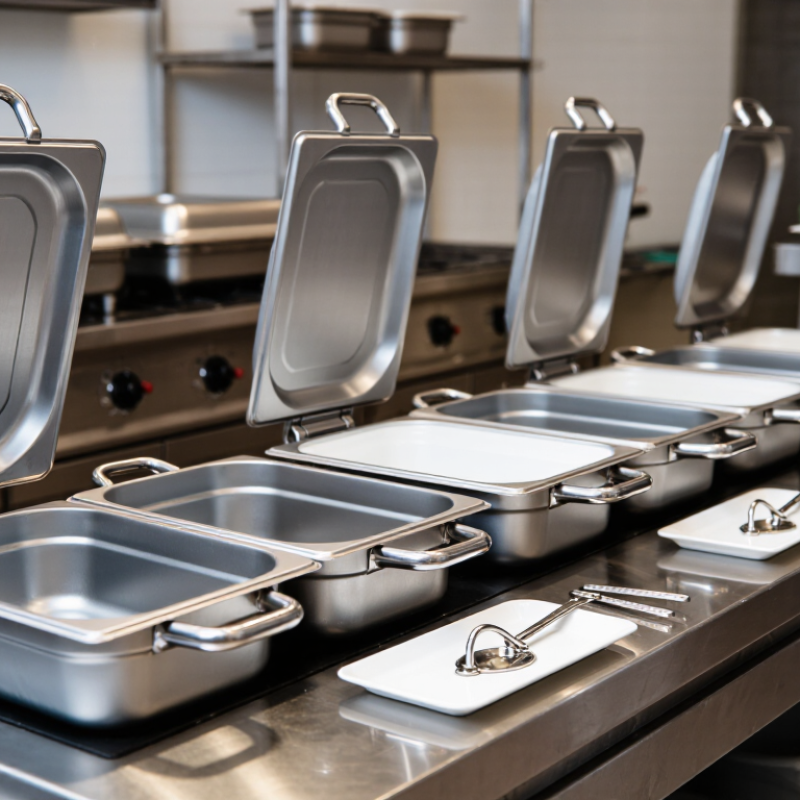
Dimensions require equal attention. Confirm whether the Buffet Food Pan follows standard GN sizes, such as GN 1/1 or GN 1/2. Measure the chafing dish, warmer, or heated counter already in use. Depth also affects portion control and heat performance. A deep pan may hold more food, but it can slow serving and increase refill pressure. That detail is easy to miss.
Think beyond appearance. A good pan should support safe handling, stable stacking, simple cleaning, and consistent presentation. Ask about temperature resistance, surface treatment, packaging, replacement parts, and delivery reliability. Supplier communication matters too. Clear drawings and honest test results are more valuable than impressive product photos.
Some buying decisions remain imperfect. The cheapest option may appear efficient, yet hidden transport damage or poor polishing can raise long-term costs. Even experienced buyers should test a small batch first. These practical checks can help restaurants, hotels, caterers, and distributors choose with greater confidence.
Match Capacity to Service Volume: 1/1 GN Pans Measure 530 × 325 mm (EN 631)
For global buyers, pan capacity should follow service volume, not guesswork.
A 1/1 GN pan has nominal dimensions of 530 × 325 mm under EN 631. This footprint suits many standard gastronorm counters, ovens, chillers, and bain-marie units.
Measure the rush.
A 65 mm deep pan may suit salads or shallow side dishes. Deeper 100, 150, or 200 mm pans hold more food, but they become heavier when full.
Estimate peak demand before selecting depth. For a 120-guest breakfast, calculate portions served within the busiest 20 minutes. Refill frequency also matters. Two medium-depth pans may provide better rotation than one very deep pan.
Food temperature, product density, and serving utensils can change the practical capacity.
Depth changes everything.
Soup needs different handling from roasted vegetables.
Check the pan’s usable internal dimensions, not only its external size. Inspect rim flatness, corner finishing, wall thickness, stacking clearance, and resistance to repeated washing. Stainless steel is common, but its grade and finish still require verification. Confirm temperature limits for hot holding, refrigeration, and oven use. Packaging should protect rims from dents during international transport.
The tempting mistake is choosing the largest volume without considering lifting safety or staff access.
Small details matter.
A pan that fits equipment but slows replenishment is not an efficient purchase.
Select Durable Materials: AISI 304 Stainless Steel Commonly Uses 18% Chromium
For global buyers, material selection should start with the pan’s chemistry, not its polished appearance. AISI 304 stainless steel commonly contains about 18% chromium, which forms a thin passive oxide layer. This layer helps resist moisture, food acids, and everyday corrosion.
The protection is practical, but not unlimited. Chloride-rich cleaners, salty foods, and trapped water can cause surface staining or pitting. The Nickel Institute’s technical guidance identifies 304 stainless steel as widely used in food-contact equipment, while recommending suitable cleaning practices and proper surface maintenance. Look for smooth interiors, rounded corners, and fully finished welds. These details reduce residue buildup around seams.
Check the mill certificate before ordering large quantities. ASTM A240 chemistry requirements commonly place Type 304 chromium near 18%, but actual limits can vary by specification. Do not trust “304” stamped on a carton alone. A small mistake.
World Stainless reported approximately 60 million tonnes of stainless steel production worldwide in 2023, showing the material’s broad industrial adoption. However, high production volume does not guarantee every buffet pan is durable. Compare thickness, flatness, weld quality, and temperature performance. Thin pans may warp after repeated heating and cooling. Ask for independent testing when specifications seem vague. In real kitchens, a dependable pan should remain stable after washing, stacking, and daily service—not only look bright during inspection.
Buffet Food Pan Buying Tip: Compare Stainless Steel Chromium Content
Chromium helps stainless steel form a passive protective layer against corrosion. AISI 304 stainless steel commonly contains at least 18% chromium, making it a widely used option for durable buffet food pans.
Values show the commonly specified minimum chromium content by mass for representative stainless steel grades. Actual composition may vary by applicable material standard.
Choose Pan Depth Strategically: 65, 100, and 150 mm GN Sizes Suit Varied Loads
For global buyers, pan depth should match the food load, service speed, and cooling method. A GN 1/1 pan measures 530 × 325 mm under the EN 631 dimensional framework. Its theoretical volume is about 11.2 litres at 65 mm, 17.2 litres at 100 mm, and 25.8 litres at 150 mm. These figures assume straight walls. Real fill levels are lower. That difference matters.
Choose 65 mm for roasted vegetables, pastries, sliced proteins, and fast buffet turnover. The shallow profile improves serving access and reduces food compression.
A 100 mm pan suits rice, pasta, stews, and medium-volume replenishment. It offers useful capacity without making ladling awkward.
The 150 mm option handles large batches, but it can hide leftovers and slow heat transfer. Depth is not capacity alone.
The 2022 FDA Food Code requires cooked food to cool from 57°C to 21°C within two hours, then to 5°C within six hours total. Deep pans may complicate this process unless kitchens divide portions or use rapid cooling equipment. The UNEP Food Waste Index Report 2024 estimates that 1.05 billion tonnes of food were wasted in 2022. Smaller, frequently replenished pans may therefore support tighter portion control. In my experience, buyers often choose 150 mm for volume, then discover heavier lifting and more waste. Measure the busiest service period, not the largest possible event.
Verify Temperature Performance: Hot Holding Requires at Least 57°C/135°F (FDA)
For global buyers, temperature performance should be a core buffet food pan requirement. The FDA Food Code 2022, Section 3-501.16, requires hot-held time/temperature control foods to stay at least 57°C/135°F. This is not a decorative specification. It affects food safety, service quality, and inspection readiness. The CDC estimates that foodborne illness causes about 48 million illnesses annually in the United States. Poor hot holding can become an expensive operational weakness.
Tip: Ask suppliers for test data at 57°C/135°F, not only maximum-temperature claims. Check the pan after loading it with food, because real service differs from empty-pan testing. Request results for several hours, including the coldest corner. A thermometer alone is not enough. You need evidence.
Choose pans with even heat distribution and stable contact with the heating unit. Thin metal may warm quickly, but it can also create hot spots. Uneven heating may leave rice or sauce below the required limit.
Measure food temperature at multiple points during a live trial. Record readings every 30 minutes. Small gaps in the record are easy to overlook. That is a weakness worth admitting and correcting.
For international purchasing, also verify metric markings, compatible lids, and documentation using both Celsius and Fahrenheit. Suppliers should state test conditions, food load, ambient temperature, and measurement method clearly. Be cautious with vague phrases such as “keeps food hot.”
Check Hygiene and Compliance: NSF/ANSI 2 Covers Commercial Food Equipment
When buying buffet food pans globally, hygiene should guide the specification, not only price or appearance. NSF/ANSI 2 addresses commercial food equipment construction, materials, fabrication, cleanability, and sanitation. It can help buyers assess whether a pan is designed for safe food handling. However, compliance is not automatic. Ask for current certification documents and confirm that the certificate covers the exact pan, material, and intended use.
Look closely at the pan’s corners, seams, handles, and surface finish. Smooth, rounded edges leave fewer places for food residue to collect. Strong welds should be even and easy to inspect. Stainless steel may resist corrosion, but poor finishing can still create cleaning problems. Check whether the pan fits standard wells, heating units, and lids without forcing it. Measure carefully. A small mismatch can cause spills, unstable stacking, or uneven heat.
Temperature limits also matter. Confirm whether the pan is suitable for hot holding, chilled service, or both. Request test reports, material details, cleaning instructions, and traceability records. Local rules may require additional documentation beyond NSF/ANSI 2. A certificate copy alone is not enough; verify its issuing body and scope. I once treated a polished surface as proof of quality, which was a weak assumption. Inspect samples when possible. A practical checklist can reduce risk, but it cannot replace hands-on evaluation.